The evolution of financial data infrastructure resonates in tandem with China's financial digital transformation. From early distributed small-scale data centers to today's full-stack cloud-native architectures, the financial industry's IT support framework has undergone multiple rounds of technological leaps. With the maturation of mobile payment ecosystems and the refinement of intelligent risk control systems, data infrastructure has elevated from a traditional back-office support role to the core engine driving business innovation — imposing entirely new heights of demand on power continuity, system fault tolerance, and automated O&M capabilities.
The current banking operational model has undergone profound restructuring. From real-time clearing to intelligent credit approval, from online wealth management to digital RMB applications, the deployment of every new financial service is highlydepends heavily on the reliable operation of underlying data infrastructure. Especially under the dual drivers of core accounting system distributed architecture transformation and agile business continuous deployment, financial institutions have raised unprecedented high standards for infrastructure elastic scalability, fault domain isolation effectiveness, and O&M automation maturity.
At the policy level, high-standard frameworks for financial-grade data centers are being rapidly established. The People's Bank of China explicitly requires building green, highly available next-generation data centers in its FinTech Development Plan, while regulatory bodies have set strict entry thresholds for PUE energy efficiency metrics, disaster recovery system levels, and security compliance standards. Combined with the nation's continued advancement of computing infrastructure deployment and low-carbon policies, the finance industry is accelerating toward a modern data center system that is energy-efficient, elastic, and intensively managed.
Industry Insights

Financial Data Infrastructure Undergoes Accelerated Restructuring in the Intelligent Era
Business Requirements
High-Availability System Assurance
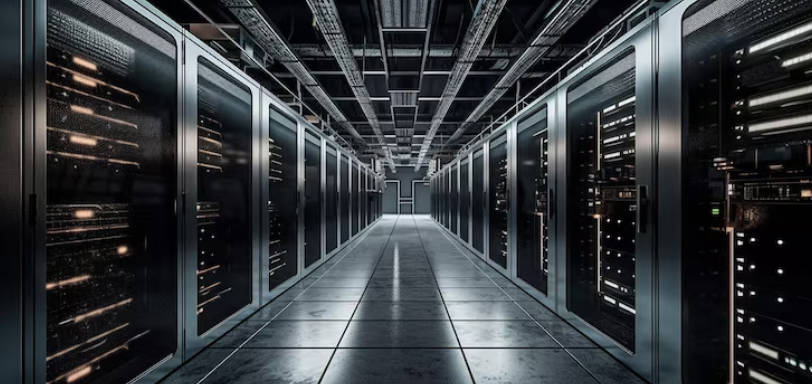
Building a leading financial digitalization system begins with solidifying the reliability foundation of underlying infrastructure. As financial data center scale continues to expand, power distribution capacity has climbed from initial thousands of kVA to tens or even hundreds of thousands of kVA. Financial-grade data centers must possess the capability to handle sudden traffic surges, support massive data throughput, guarantee high transmission rates, and meet security compliance requirements for year-round uninterrupted operation — stability and security are the fundamental prerequisites for efficient financial business operations.

Energy Conservation & Environmental Requirements
Financial data centers are under increasingly heavy energy consumption regulatory pressure. Regulatory bodies explicitly require PUE for new large data centers to drop below 1.3, while in-service data centers must complete energy efficiency upgrades within specified timelines. Financial institutions must employ comprehensive strategies including high-efficiency power equipment, optimized airflow management schemes, and natural cooling system deployment while maintaining business continuity, to achieve refined energy consumption governance.


Automated O&M System
Centered on proactive prevention, achieving platform support for integrated management, process-driven scheduling, and intelligent diagnostics — thereby attaining the goals of efficient operations, reduced manual intervention, compressed maintenance costs, optimized resource allocation, and enhanced overall O&M effectiveness.


Solutions & Product Portfolio
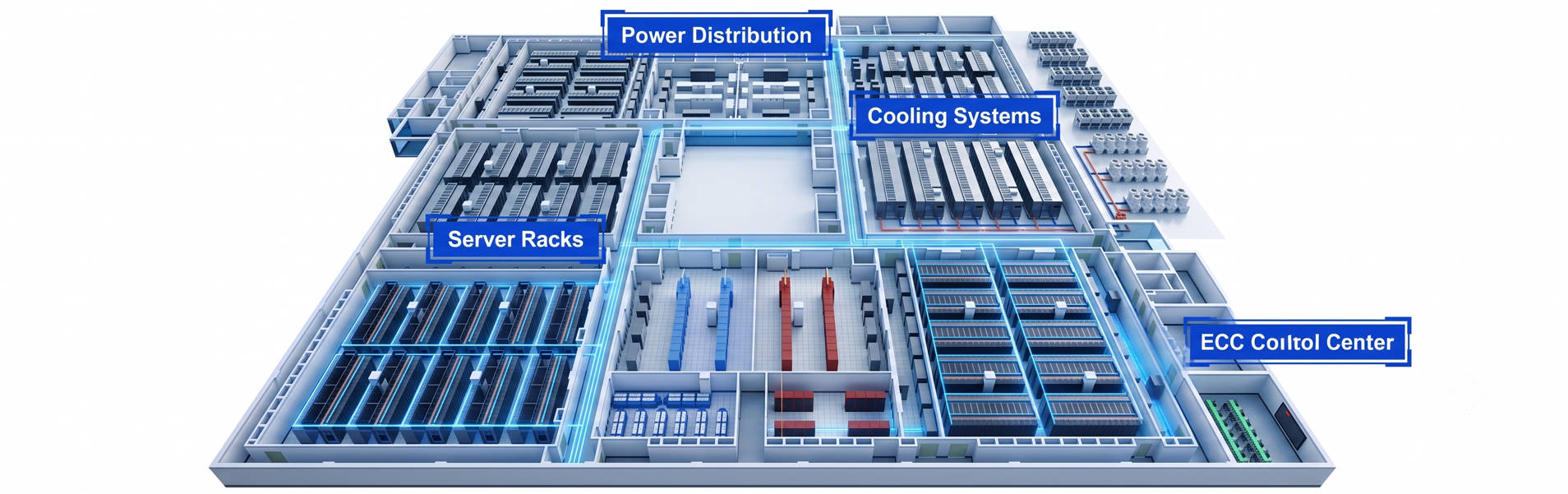
As the critical hub of the digital finance era, financial data centers carry transaction flows worth trillions. Addressing the finance industry's rigid demands for highest-grade availability, we have built a full-scenario solution matrix covering core data centers, regional centers, and front-end branches. Through deep integration of UPS systems, modular data centers, and intelligent power distribution products, we deliver standardized prefabricated solutions realizing financial customers' comprehensive expectations for high availability and intelligent O&M, achieving synergy at headquarters-grade data centers, smart branches, and multiple other scenarios.
"1+1>2" synergy effects.
Smart Branch Scenario Solutions: As bank branches accelerate their transformation from transaction-processing to experience-marketing models, branch equipment rooms now gather diverse devices including ATMs, smart teller machines, and interactive advertising screens, making the power distribution environment increasingly complex. We offer miniaturized, highly integrated uninterruptible power solutions for financial institution endpoint branches, achieving highly reliable continuous power assurance with minimal footprint.
Smart Branch Scenario Solutions: As bank branches accelerate their transformation from transaction-processing to experience-marketing models, branch equipment rooms now gather diverse devices including ATMs, smart teller machines, and interactive advertising screens, making the power distribution environment increasingly complex. We offer miniaturized, highly integrated uninterruptible power solutions for financial institution endpoint branches, achieving highly reliable continuous power assurance with minimal footprint.
Core Data Center Product System
Classic Cases
China Merchants Bank Intra-City Active-Active Data Center
China Merchants Bank's largest intra-city active-active data center, planned to accommodate 120,000 servers with total power distribution capacity of approximately 80MVA. The entire project lifecycle — from design and construction to operations — strictly follows Uptime T4 international standards, meeting the highest regulatory requirements of the National Financial Regulatory Administration.
Technical Solution
1. Deployed 60 units of 500kVA and 4 units of 400kVA UPS systems
2. Standardized 15-minute lithium battery energy storage configuration across all systems
3. Micro modules adopt enclosed hot/cold aisle design, integrated with intelligent DCIM, paired with 2600mm high-standard cabinets
Customer Benefits
1. IT UPS uses 2N redundant parallel architecture, ensuring business continuity
2. Lithium battery energy storage system is green and efficient, saving approximately 60% data center floor area — 60 units cumulatively save nearly 650 sqm
3. Intelligent busway solution boosts cabinet deployment rate by 10%
4. Micro modules achieve refined energy efficiency management, equipped with visualization screens for convenient O&M operations
Industrial Bank Headquarters Data Center
Industrial Bank's high-grade data center was recognized as a 2021 National Green Data Center. The center pioneered construction of a bank-wide unified data center intelligent O&M management system among joint-stock banks, and adopted domestically developed high-power UPS and modular data center products at large scale, achieving autonomous control of critical infrastructure.
Technical Solution
1. UPS system uses 2N heterogeneous redundant architecture with 40 sets of 500kVA
UPS systems, four units in parallel, with 1200A busbar connections on input/output sides
2. Over 2,500 cabinets deployed, over 65 modular data center units
3. Achieved unified monitoring and centralized management of headquarters and all branch data centers
Customer Benefits
1. Awarded the 2021 Financial Technology Innovation Outstanding Contribution Award
2. High security and autonomous control: critical UPS uses domestically developed brands, balancing product quality, delivery efficiency, and total cost
3. PUE reduced by 0.03 compared to pre-renovation levels
CITIC Securities Intra-City Disaster Recovery Data Center
The CITIC Securities Technology Operations Center disaster recovery facility serves as a critical data and communications aggregation node, essential for ensuring continuous operation of its core business, imposing extremely high requirements on security classification and system reliability. The project scope covers the main power distribution room, computer room, and rooftop facilities, designed and constructed to national Grade-A data center standards.
Technical Solution
1. Power Distribution: 2 sets of 1.6MW integrated power modules
2. Modular Data Center: 8 intelligent micro modules + 32 units 50kW refrigerant pump precision AC + 16 intelligent busways
3. Monitoring Platform: 1 DCIM intelligent O&M management system
Customer Benefits
1. Integrated Power Module Solution: saved approximately 30% footprint, reduced delivery cycle by 60%, improved system efficiency by 1%, supporting highly reliable electrical system O&M
2. Data center actual operating PUE below 1.3
3. All critical equipment uses domestically developed brands, meeting financial sector independent technology requirements
4. Awarded the 14th "Financial Technology Application Innovation Award"